
Professor Shu Zhu Named to Cell's 50 Inspiring Scientists for the Future List
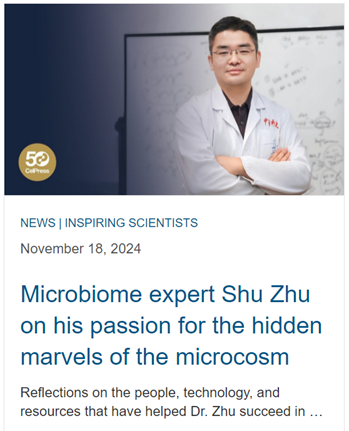
To celebrate the 50th anniversary of Cell, Cell Press has launched the "50 Scientists that Inspire" feature, spotlighting outstanding scholars worldwide who drive innovation and transcend disciplinary boundaries in scientific research. Professor Zhu Shu from the University of Science and Technology of China has been selected for this honor in recognition of his groundbreaking research at the interface of the microbiome and the immune system, and has accepted a featured interview with Cell, sharing his research journey, scientific insights, and vision for the future of science

Professor Zhu Shu currently serves as Vice Dean (Presiding) of the School of Life Sciences and Medicine and Executive Dean of the School of Basic Medical Sciences at the University of Science and Technology of China. His research team focuses on the interactions among diet, microorganisms, and the immune system in the gut and their impact on human health and disease, aiming to develop precision therapeutic tools for immune and neurological disorders. For his pioneering research, Professor Zhu has received numerous honors, including MIT Technology Review's 35 Innovators under 35 China and the Qiushi Outstanding Young Scholar Award. In addition, he is the founder of Ibiome Biotechnology, which is dedicated to developing innovative therapies for immune and neurological diseases using live bacteria or their metabolites. In this interview, Professor Zhu Shu shared the sources of inspiration for his scientific exploration, the driving forces behind his career success, and his advice for future scientists, encouraging young researchers to remain curious and to be adept at learning and collaboration
1. What inspired you to become a scientist?
My path to science was not triggered by any particular moment but was driven by an ever-growing inner curiosity and the profound influence of personal experiences.
As a child, my dream was to become a football player; in college, I aspired to be a photographer for National Geographic, capturing the magnificent beauty of the natural world through the lens. However, witnessing my grandmother's long-term suffering from rheumatoid arthritis and her eventual passing instilled in me a strong sense of mission to study immune-related diseases. During my graduate and postdoctoral training, I focused on exploring the intricate mechanisms of immune cells, cytokine signaling pathways, and gut microorganisms. Through this process, I developed a deep interest in the mysteries of the microscopic world and the exquisite workings of the immune system—particularly the complex and far-reaching interactions between gut microorganisms and the immune system, which revealed to me the boundless allure of scientific research.
As my career has progressed, this passion has not diminished but has grown even stronger. I feel especially inspired and energized when I realize that our research has the potential to advance human health. Currently, my research interests center on how the immune system recognizes and responds to various pathogens, commensal microorganisms, dietary components, and chemical substances in the gut. I look forward to revealing these complex biological processes through sustained research and contributing more scientific discoveries to human health.
2. How do you define innovation in science?
In my view, the essence of scientific innovation lies in two aspects: first, creating entirely new knowledge, and second, advancing the improvement of human health. These two goals have always been the core objectives of our laboratory's work and represent my fundamental understanding of innovation.
3. What important developments do you foresee in this field in the next 50 years?
The gut is a complex and critical interface where the interactions among food, microorganisms, and the immune system exert profound effects on human health. With the deepening of interdisciplinary research and the integration of new approaches from immunology, microbiology, nutrition, gastrointestinal physiology, and computational science, I believe this field will witness several important breakthroughs in the future:
(1) The application of emerging technologies will significantly enhance our understanding of immune recognition and microbial regulation mechanisms. For example, spatial metabolomics, metabolic flux analysis, microbial engineering, in vivo functional screening, and machine learning will help us construct a chemical-based network that precisely reveals the relationships among nutrients, microorganisms, and the immune system.
(2) High-throughput screening systems will provide new approaches for deciphering the antigen specificity of gut-adapted immune cells. For instance, applying generative AI to T cell or B cell receptor databases and their corresponding antigens may enable the prediction of antigen epitopes, or the identification of corresponding receptor types based on antigen sequence features. This will greatly expand our understanding of how the gut immune system generates specific immune responses to complex environments.
(3) Building on breakthroughs in the above areas, we will be able to develop more personalized immunotherapeutic approaches that, beyond traditional drugs, can intervene in diseases through dietary adjustments, the use of commensal microorganisms or their metabolites. This precision immunotherapy, based on individualized immune profiles, will bring revolutionary changes to optimizing therapeutic outcomes and improving health conditions.
4. What advice would you give to young researchers?
My advice is to stay curious, find your own research passion, and remain open to new ideas and new technologies.
On the path of science, it is essential to maintain critical thinking about both your own experimental data and the research findings of others. Failure and negative results are inevitable parts of scientific research, and it is particularly important to learn to accept them and draw lessons from them. Furthermore, collaborating with experts from different fields is key to scientific progress, and cultivating an open mindset and a willingness to learn from others is crucial.
5. What has been the biggest challenge in your career?
I am deeply grateful for the abundant resources and opportunities available at my current institution, including generous research funding, advanced research platforms, outstanding team members in the laboratory, and rich opportunities for interdisciplinary collaboration. These supports have greatly facilitated the scientific discoveries made by my team and me.
For me, the biggest challenge at present is that I only have 24 hours in a day.
Original link: https://www.cell.com/news-do/50-inspiring-scientists-shu-zhu
Cell 50th Anniversary 50 Scientists that Inspire: https://www.cell.com/topic/cell-do-taxonomy/cell-news-inspiring-scientists